

 See My Latest Article on HelloNation
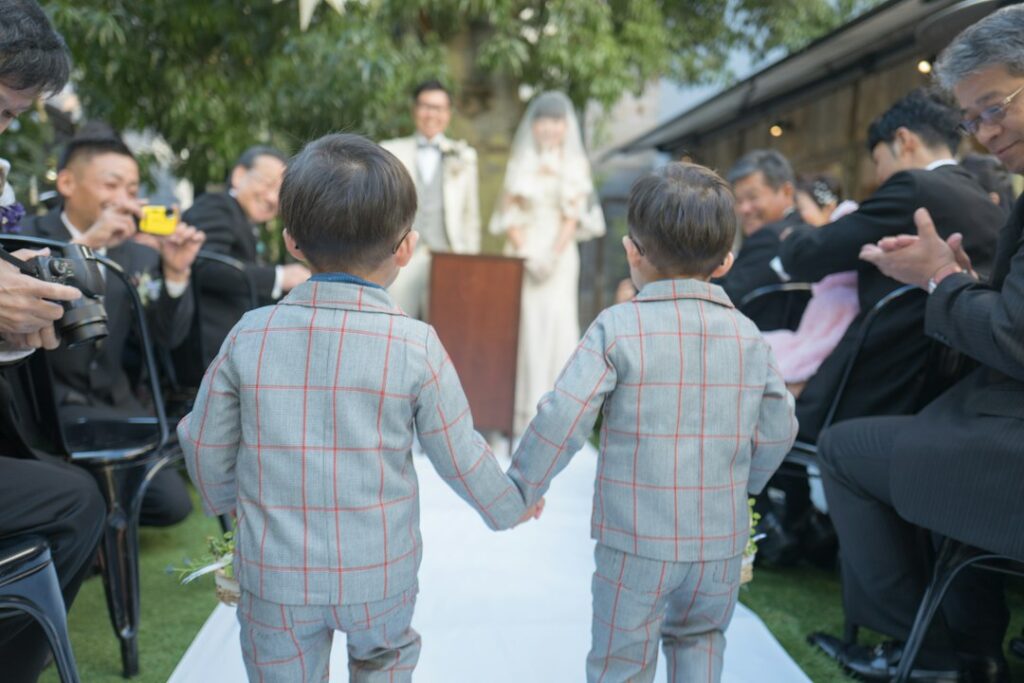
Which children can take part in the ceremony?
Children can participate at nearly any age, but the role should match their attention span, comfort level, and relationship to the couple. A toddler may be happy walking with an adult, while an older child may be ready to read, carry a meaningful item, or stand with the wedding party.
Possible roles include:
- Flower child or ring bearer
- Junior attendant
- Ceremony reader
- Sign holder
- Escort for a parent or family member
- Helper with a unity ritual
- Participant in a family vow or blessing
- Member of the wedding party
- Guest who receives a special acknowledgment
The most successful plans give children a clear responsibility without making the ceremony depend entirely on perfect behavior. A child can have an important place in the ceremony even if the role lasts only a few minutes.
How should the role match the child’s age?
Age is only one factor. Personality, sensory needs, mobility, and familiarity with formal events matter just as much.
Toddlers and preschool-age children
Young children often need the most flexibility. They may walk down the aisle, scatter petals, carry a small sign, or simply stand beside a trusted adult. Some children will participate confidently during the rehearsal and then become shy or distracted during the ceremony.
Avoid giving a toddler an irreplaceable object, such as the actual wedding rings. Decorative rings, a small pillow without loose parts, or an empty basket may be safer and easier to manage. An adult should remain close enough to help without making the child feel pressured.
Elementary-age children
Children in this age group may be ready for a short reading, a simple musical role, or a place beside the couple during a family-centered ceremony. Instructions should be concrete and brief. Rather than saying “act appropriately,” explain exactly what will happen: where to stand, when to walk, and who will signal the next step.
Preteens and teenagers
Older children can take on more visible responsibilities, such as delivering a reading, helping with a unity ceremony, escorting a family member, or participating in vows. If a teenager is part of the wedding party, include them in planning conversations about clothing, timing, and what they are comfortable saying publicly.
Should children be included in the vows?
Children may be included in the vows when the marriage also represents a new or continuing family relationship. This can be meaningful in blended families, adoptive families, and households where children already share a close bond with both partners.
The wording should be appropriate for the child’s age and should not place adult responsibilities on them. A couple might promise to provide care, honesty, patience, and a welcoming home. Children might respond with a short phrase, exchange a small keepsake, or simply be acknowledged by name.
Avoid asking children to promise that family relationships will always be easy or that they will take responsibility for keeping adults happy. A ceremony should recognize connection without making a child responsible for the success of the marriage.
What ceremony activities work well for children?
Children usually respond better to an activity they can see and understand than to a long explanation. A family unity ritual can provide a simple focal point, but it should be safe, brief, and easy to complete.
Options may include:
- Adding individual colors of sand to one container
- Placing flowers into a shared arrangement
- Lighting a unity candle with adult assistance
- Presenting a family keepsake
- Sharing a short reading or poem
- Signing a family certificate or ceremonial document
- Offering a group blessing, moment of gratitude, or family statement
Outdoor ceremonies require additional planning. In Colorado Springs, CO, sunlight, wind, temperature changes, and elevation can affect children more quickly than adults. Lightweight objects may blow away, candles may be difficult to manage outdoors, and formal clothing can become uncomfortable in strong sun or cool weather. A shaded waiting area, water, layers, and a quiet place to step away can make participation easier.
How can parents prepare children without creating pressure?
Preparation should feel like practice, not a test. A rehearsal can show children where to walk and stand, but it should also demonstrate that adjustments are allowed.
Useful preparation includes:
- Explaining the ceremony in simple, honest language
- Showing children the aisle, seating area, and ceremony space in advance
- Practicing with the actual basket, sign, pillow, or book
- Identifying a trusted adult who can guide or comfort them
- Discussing what to do if they forget a step
- Choosing clothing that allows normal movement
- Planning a snack and bathroom break before the ceremony
- Letting the child ask questions without dismissing concerns

Children should know that they are allowed to feel nervous. Telling them they must not cry, fidget, or make a mistake can increase anxiety. A calm explanation that adults will help if something goes differently is usually more reassuring.
What should happen if a child refuses to participate?
A child should not be forced to walk, speak, stand, or perform. Refusal may result from shyness, fatigue, sensory overload, unfamiliar surroundings, or a change in expectations. The ceremony plan should include a backup that protects the child’s dignity.
An adult might walk with the child, carry a very young child, or allow the child to join from the front row. Another option is to include the child in a private family moment before or after the ceremony rather than in the public portion.
The couple can also assign a role that does not require entering the aisle. A child might hand over a keepsake before guests arrive, sit with family during the ceremony, or participate in photographs later. Inclusion is about belonging, not public performance.
How should the ceremony account for children who are attending as guests?
Children do not need formal roles to feel included. If several children will attend, consider the ceremony length, seating arrangements, sound level, and access to a quiet area. Families may appreciate knowing whether children can move in and out during the ceremony, especially when the event is outdoors or held in a space with limited room.
A designated adult should supervise children rather than assigning that responsibility to the couple, officiant, or wedding party. This allows parents to participate in the ceremony while ensuring that a child can leave if needed.
For younger guests, avoid placing fragile decorations, open flames, or loose objects where children may reach them. Keep aisles clear, particularly if children will be walking or if guests may need to exit quickly.
What are common mistakes to avoid?
Several well-intended choices can make participation harder than necessary.
- Giving a young child a role that requires memorization
- Expecting children to remain still for a long ceremony
- Using uncomfortable clothing or difficult footwear
- Treating a mistake as embarrassing
- Making a child promise something beyond their understanding
- Failing to identify an adult backup
- Waiting until the ceremony begins to explain the plan
- Assuming siblings will behave the same way
- Using real rings or breakable objects as props
- Ignoring weather, shade, wind, or temperature
The ceremony should be designed around realistic conditions, not an idealized photograph. Children can walk slowly, speak quietly, become distracted, or need help. These moments are normal and can be handled gracefully when the plan allows room for them.
How can children be included without making the ceremony too long?
A child’s participation can be meaningful without adding much time. A name in the vows, a brief reading, a family ritual, or a place beside the couple may take less than a minute. The clearest ceremonies usually give each child one manageable responsibility rather than several complicated tasks.
Before finalizing the ceremony, consider whether the child understands the role and whether the activity reflects the family’s real relationship. A small, genuine moment often feels more personal than a highly staged performance.